Showing posts with label state security. Show all posts

Sunday, July 17, 2011

Assuring Accountability for the Egyptian Security Sector

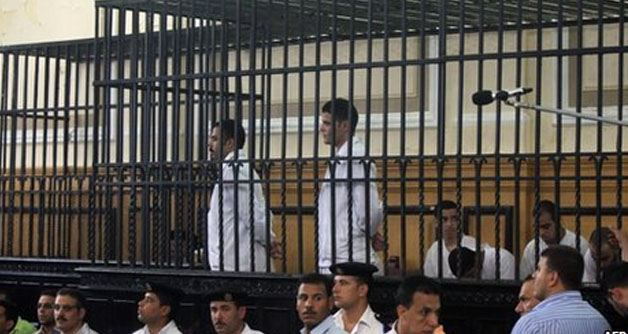
Egyptian Police on Trial for Killing Protesters
Egypt’s revolutionary youth recognize the importance of reforming the security sector to the future of Egypt. Their targets have included the police, prisons, State Security, Ministry of Interior and the Supreme Council of the Armed Forces (SCAF). Yet they have yet to develop an integrated view of the security sector. They do not yet have a clear vision on how the security sector must evolve to meet the needs of the Egyptian people and be accountable to them. Such a vision could be based on the concept of security sector reform (SSR), an idea that developed from the realization by many governments, academics, civil society actors and donors that strengthening law and order and security must be integrated with efforts to promote democratic development.

Attempts to Rein in the Security Sector

Prior to the January 25 revolution, anger against the police and state security had been mounting for decades. Under the emergency law, police abused human rights, tortured suspects and political opponents, and were free to engage in corruption. Some judges followed the dictates of the Ministry of Interior on important cases.  Prisons held thousands of political prisoners. State Security was omnipresent, intimidating anyone who could potentially challenge the ruling party.  Retired military leaders held major government positions and served as centrally appointed governors for many governorates. The military gained control of large portions of the economy through investments in key sectors. Civil society had no effective power to challenge abuses of these security sector institutions. The media had limited ability to analyze and report on them. The Parliament, captured by the ruling National Democratic Party, was too weak and disinterested to provide effective oversight.

Anger about the population’s treatment by security forces helped inspire activists to organize the first revolutionary demonstrations on Police Day, the day set aside to celebrate the police.  Over the next 18 days, police killed perhaps 800 protestors and wounded thousands more.  State Security facilitated attacks on protestors by thugs. Many police stations were burned, and prisons attacked.  Several days into the demonstrations, the Ministry of Interior, hoping to turn the population against the protestors, removed police from the streets. An ensuing crime wave forced residents to form neighborhood protection committees, in recognition that State Security had turned against the population and that the police were not serving their needs. Since February, the number of police on the streets has not increased to its previous levels, and many police have been reluctant to take steps to control crime. Individual safety has deteriorated significantly.

The Supreme Council of the Armed Forces ordered President Mubarak to give up power on February 11. Protestors welcomed this step, declaring that they had complete trust in the military.  In February and March, the military stationed soldiers, tanks and other equipment in sensitive areas.  Hundreds of protestors were arrested and tried by military, rather than civilian courts. Some of those arrested complained of torture. Protestors attacked State Security Offices and retrieved files kept on political dissidents.  Recognizing the rage of the population over mistreatment by State Security, the Minister of Interior announced the dissolution of the Agency, to be replaced by an organization called National Security, with the sole mandate of addressing terrorism. 

Demonstrators and their families grew increasingly frustrated at delays in prosecuting those police identified as killing protestors.  In early July, demonstrators were outraged when a judge ordered the release on bail of seven police accused of killing protestors in the town of Suez.  Police then used tear gas and force against the family members of those killed, after some of them were excluded from a memorial service. Consequently, activists organized the second phase of the revolution, when hundreds of thousands of people took to the streets to express their displeasure at the Supreme Council of the Armed Forces and the Prime Minister.  The SCAF, in turn, vowed not to interfere with trials, in order to protect judicial independence. However, they recognized that justice must be expedited. In mid-July, the Ministry of Interior reshuffled about 4,000 police, including those held responsible for the killing of protestors and those believed to be corrupt. About 500 police generals and 150 senior officers were forced to take early retirement.  The Minister declared this reshuffle the largest in Egypt’s history.

Security Sector Reform

Transformation of the security sector is based on the understanding that people need safety and security through services that are accountable to them and protect their human rights. It also recognizes that the state needs to be protected from attack beyond its frontiers, but that military and intelligence services must operate within the rule of law. Safety and security require not only competent police, but also effective prosecutors and independent judges committed to the rule of law.  The aim is to reform security forces and services so they have clear and appropriate roles; adequate resources, training and incentives to achieve them; and operate in a manner that is both transparent and accountable to those they serve.  Security sector reform also requires empowerment of civil society, the media and Parliament, so that they provide appropriate oversight and demand accountability.  Where there are non-state security forces such as militias and thugs, SSR requires their removal or strict control.  An effective security sector requires common expectations and effective coordination by elected leaders, security forces and services, civil society and the media.   A good reference on security sector reform is “Safety, Security and Accessible Justice,” prepared by United Kingdom Department for International Development in July 2002, http://www.gsdrc.org/docs/open/SSAJ23.pdf.

In Egypt, the security sector requires reform desperately.  With support from international donors, military leaders, police and prosecutors have been trained on human rights and anti-corruption.  Such training is far from sufficient. The country requires a major transformation of the culture and institutions of the police and intelligence services, as well as clarification of the roles of the military and the prosecutors. In addition, judges need to be protected from interventions from security services and the executive branch.  The military has had difficulty playing its temporary role of leading the government overtly.  After elections, it will have an opportunity to focus more on national defense. However, it should remove itself from all aspects of governance, including withdrawing retired military leaders from high government positions.  Ideally, it should also give up control of its economic investments, which enables it to operate without civilian control. The new Parliament must gain an understanding of what to expect from the security sector, how to use the budget as a tool to control it, and how to use its capacity to summon officials to provide close oversight.  The media requires improved investigative journalism skills. Civil society organizations also need to be clear about what they expect from the security sector.  They should organize a movement to promote the sector’s reform and sustain efforts to monitor its transformation.  

Initiating Security Sector Reform in Egypt

With each institution requiring so much attention, it is difficult to determine where to start.  Revolutionary youth and political party and civil society leaders are in a good position to initiate the process, although implementation will require close coordination with elected leaders and each service.  All of these actors need to develop a deep understanding of security sector reform. To facilitate dialogue, Egyptian research institutes, with help from retired security sector officials, should undertake analyses of each service.  Each analysis should focus on the service’s current and desired role, culture, leadership, information system, inspection, incentive structure and customer service. In addition, it should assess the service’s coordination, transparency, accountability, and commitment to the rule of law and human rights.  Such studies will enable those outside the government to raise questions and identify issues that must be addressed by elected leaders and the services themselves. Further, these assessments will provide the basis for oversight by civil society, the media and Parliament as the process of security sector reform continues.

One methodology for a Security Sector Reform assessment is provided by USAID in its “Interagency Security Sector Assessment Framework,” October 2010, www.afcea.org/events/nps/11/documents/ISSAFFinal_001.pdf.   Egyptian researchers have made some initial efforts to assess the security sector in the post-revolutionary period. (See “Egyptian Security Sector Reforms,” Mohamed Kadry Said and Noha Bakr, January 2011,   http://arab-reform.net/IMG/pdf/Egypt_Security_Sector_Reforms-M-Said_and_Noha_Bakr_Eng.pdf) and “Reforming the Egyptian Security Services,” Tewfick Aclimandos, June 2011, http://www.arab-reform.net/IMG/pdf/Security_Sector_Reform_Tewfick_Aclimandos.pdf.

Security sector reform will not take place overnight in Egypt.  However, common awareness of the objectives and required process will keep the issue alive for the many years that will be required for these transformations to occur.   The benefits to Egyptian citizens and civilian leaders will be evident early on, while security sector personnel will gradually become more comfortable with their new roles.
Rick Gold
cross-posted in Secular Perspectives

Sunday, April 10, 2011

Moving Toward a Civilian-led Egyptian Government


Many Egyptians, despite having great pride in the armed forces, dream of the day when the military no longer rules society.  To do so, they must build the power of civilian authorities to exercise control over the military. To begin this process, they must put in place a constitution that institutionalizes democracy, assures the rights of minorities and guarantees civilian control of the military.

The revolution, which was sparked by Egyptian youth, led the military to play a more overt role in governing Egypt.  In fact, the military had been in control of the country since it took power from the monarchy in 1952. Nasser, Sadat and Mubarak all came from the military, and many Government leaders either had military backgrounds or were selected by the military.

Most Egyptians have faith that the Supreme Council of the Armed Forces (SCAF) will facilitate the election of a new parliament and president.  Such faith is not based on modern Egyptian history, however. Egyptians believed that the military would cede power to a civilian government in 1952, but Nasser took power instead.  This time, the military is more likely to step aside, for two important reasons:

1. It has built its power through control of major parts of the economy, including industry and land, so it has little need to control government directly as well.

2. Through its massive military assistance program, the US Government has trained many leaders to understand the role of the military in a democratic society. Some Egyptians believe that the US pressured the Egyptian military into removing Mubarak and pledging to transfer power to a civilian government.

The underpinning of any modern state is its constitution or set of basic laws.  Egypt has had many constitutions over the last 150 years. The importance of constitutions has been diminished in the last 60 years due to extensive periods of time under emergency law, when many constitutional rights were set aside. Nevertheless, Egypt can only begin the transition to a civilian-led state by putting into place a new or significantly amended constitution.  Moreover, Egyptians must make sustained efforts to enforce and defend their constitution.

Constitutions represent the vision of a people for their society, state and government.  So far, Egyptians have been unable to begin the debate that leads to a common vision. Instead, they have paid more attention to casting off the baggage from the past.  After the departure of Mubarak, the Coalition of Revolutionary Youth negotiated, both around the table and at Tahrir Square, a set of demands. These demands included cancellation of the state of emergency; release of political prisoners; cancellation of the constitution; dissolution of the parliament and local popular councils; dissolution of the ruling National Democratic Party and State Security; and enforcement of judicial decisions. The Youth demanded a transitional presidential council with civil and military representatives and a credible transitional government prior to parliamentary and presidential elections. During the transition period, they expected greater freedom for political parties, stronger political rights and increased freedom of association. These rights would be enshrined in a new constitution that reduces the powers of the President, strengthens separation of power and increases the fairness of elections.
 
The SCAF, demonstrating its interest in expediting the transfer of power to an elected government, appointed a commission to propose constitutional amendments that would allow an early election of a parliament and president.  In a major break from the past, it included a Muslim Brotherhood leader in the committee. The committee proposed eight amendments, and the SCAF gave the population only three weeks to review them before voting them up or down in a referendum. 
 
The amendments made it more difficult to proclaim and maintain a state of emergency, limited the presidency to at most two four-year terms, required that "he" not be married to a non-Egyptian, strengthened judicial supervision of elections, required the president to appoint a deputy, provided easier access to presidential elections by candidates and established a commission to draft a new constitution following the parliamentary election.

Egyptians did not take advantage of the review period to analyze and debate the implications of each of the amendments.  Instead, they divided into pro- and anti-camps, based on whether they saw the referendum as increasing or hurting their chances of winning the parliamentary and presidential elections.  The revolutionary youth, the Coptic Church and many civil society groups led a campaign to vote no, based on the weakness of checks on executive authority and the fear that the Muslim Brotherhood or remnants of the National Democratic Party would win early elections. The MB and the NDP were successful in gaining the support of the population for early elections, as the referendum was approved by 77% of the 18.3 million valid votes. 

The SCAF has set parliamentary elections for September 2011 and presidential elections for November 2011, although these dates are not fixed. According to one of the approved constitutional amendments, the president and parliament will appoint a 100-member constituent assembly within six months of elections to rewrite the constitution over the course of a subsequent six-month period, which would be approved or disapproved through a referendum.

It is essential now for Egyptians to begin the profound public debate about the type of post-revolutionary society, state and government they envision and how a new constitution would enable them to achieve these goals.  Such a task is difficult, given the need to also deal with the past, develop political parties and put in place the rules and safeguards for free and fair elections.  However, delaying such a discussion will empower those forces already dominating society, such as the military, the remnants of state security, the Muslim Brotherhood, elite businesspeople and remnants of the National Democratic Party.  The solidarity among groups that participated in the Tahrir Square uprising must be maintained for Egyptians to see their common interest in putting in place a constitution that establishes a civilian led-government, provides civilian oversight of the military and other components of the security sector, provides checks and balances among democratic institutions and safeguards the interests of minorities. The constitutional debate must start now and must empower Egyptians to put in place the systems that enable groups, ideas and values to compete fairly for power. 

Rick Gold

Cross-posted in Secular Perspectives

Wednesday, February 9, 2011

The Muslim Brotherhood's Election Prospects

The Muslim Brotherhood (MB), while not a political party, is still the most important political actor outside of the ruling National Democratic Party (NDP).  Paradoxically, as a banned group, the MB has more freedom to operate than approved political parties, which suffer from both legal and security restrictions.  It is allowed to maintain a physical headquarters, a presence on the web (the English site is http://www.ikhwanweb.com) and representation in unions and school boards. It has fielded candidates for Parliamentary elections, running as independents or in alliance with other parties.  Nevertheless, the Mubarak regime frequently cracks down on MB activists, arresting and torturing them by the hundreds.  The MB has cultivated a reputation of integrity, while the NDP has developed an image of corruption and abuse of power.

Popular support for the MB is high, in the absence of viable political parties.  In the 2005 parliamentary elections, when President Mubarak allowed the MB to campaign as independents, Egyptians voted overwhelmingly for MB candidates in the first of three rounds of voting.  Fearing a complete rout by the MB candidates, State Security and National Police blocked access to polling stations and even shot at Egyptians trying to get into them. Nevertheless, the MB won 20% of the seats of the lower house of Parliament, a total of 88 seats.

Learning from these elections, the Mubarak regime put in place new restrictions that prevented the MB from winning any seats in the upper house of Parliament in 2006. The MB also was prevented from registering almost all of their candidates in the local elections in 2008. In the 2010 Parliamentary elections, the MB participated in the first round. Clearly documented election rigging prevented them from winning any seats.  They withdrew from the second round, but still managed to win one seat. The NDP, on the other hand, increased their seats from 330 to 420, with many of the 68 independents also expected to join the NDP bloc. The opposition parties, including the MB, won a total of 10 seats.

In my opinion, the MB's success in the 2005 elections was an underestimation of its electoral support at that time.  First, it purposefully chose to run candidates in only a third of Egypt's electoral districts, to avoid gaining a Parliamentary majority. Second, the repression of voters during the second and third rounds prevented the MB from gaining additional seats.  The Brotherhood's conservative approach to electoral politics also is reflected in its decision not to participate in the 2011 Presidential elections.

The MB's showing in the 2010 elections does not reflect how well it would perform in free and fair Parliamentary elections. I have emphasized in previous posts that the approved opposition parties, including the NDP and the other major parties, will require months if not years before they develop into modern political parties. The MB, on the other hand, has the organizational, technological and political expertise to run successful campaigns throughout Egypt now. I BELIEVE THAT IF PARLIAMENTARY ELECTIONS WERE HELD BEFORE 2012, THE MB WOULD WIN  DECISIVELY.

Egypt clearly needs time to develop a mature political party culture. If elections were organized before 2012, the Government could not assure that they would be free and fair or that political parties have the capacity to run well-organized campaigns.  Those negotiating Egypt's future after Mubarak leaves the scene should keep in mind the time required for political parties to be ready to compete fairly, so as not to give the MB an undue advantage.

Rick Gold

Saturday, February 5, 2011

Common Interests and Natural Divisions within Civil Society

Civil society groups familiar to international donors are a small percentage of those fighting for political reform and a post-revolutionary Egypt.  Egypt has a tremendous diversity of non-governmental actors, including service-oriented community groups, non-governmental organizations, private sector associations, religious organizations, labor movements, media and political parties.  While the vast majority of these organizations never took a position regarding political reform, all of them were forced to deal with State Security and other governmental bodies to assure their survival. They therefore had a certain degree of political awareness and an understanding of the efforts of the Mubarak regime to control all aspects of society.  Some analysts have called this phenomenon "black hole government," in which governments let no aspect of social or political life escape their control.

In reality, the Mubarak regime only exercised control over civil society groups sporadically, when it wished to make a political statement. Most of the time, it chose not to use constitutional and legal tools of repression. Consequently, many groups took advantage of the periods when the government was not paying attention to them. For example, the anti-Mubarak group Kifaya (Enough), or the Egyptian Movement for Change, formed in 2004 during a period when the Mubarak regime was using "window-dressing" to make the Bush Administration believe it was truly committed to political reform. Under the banner of opposition to Mubarak, Kifaya brought together groups with conflicting ideologies and visions, such as secularists and Islamists.  Kifaya organized many demonstrations calling for lifting the emergency laws in place since 1981, removing restrictions on forming political parties and newspapers, and  releasing thousands of political prisoners. From 2004-2007, other professional and demographic groups organized resistance against Mubarak, including teachers, students, women, lawyers, journalists and even judges. They were joined in the last three years by wildcat strikers, who refused to abide by government control of their labor unions and syndicates.  Journalists and editors were arrested or fined for writing articles that were judged too critical of Mubarak.

These broad coalitions were able to identify the lowest common denominator among the interests of their members, such as moving toward free elections, reforming the constitution, lifting emergency laws and freeing political prisoners. They recognized that these objectives were more urgent than advancing such goals as strengthening a secular form of governance, moving the legal system toward Sharia or extending civil liberties to Coptic Christians.  Secular groups and the Muslim Brotherhood found common cause in opposing Mubarak, similar to the center, left and communist parties who formed popular fronts in Europe and the US in the 1930's.

Such alliances will be hard to maintain after the fall of Mubarak.  With effort, their constituent groups will maintain enough cohesion to push through the Constitutional and legal changes required to create the democratic institutions needed to mediate their conflicting interests. Unless the Presidential elections scheduled for September 2011 are postponed, however, these alliances have a strong chance of being short-lived.

Rick Gold

Friday, February 4, 2011

USAID support to Egyptian Human Rights and Political Reform Groups

To gain insight into the anti-Mubarak movement, it is important to understand the type of support some of the key civil society organizations received from donors.  The democracy grants issued by USAID from 2005 through 2009 built the capacity of these organizations.  The major issue we confronted was whether to confine our funding to those non-governmental organizations (NGOs) that were registered with the Ministry of Social Solidarity.  Such organizations, even those dedicated to human rights, operated under severe restrictions and were under the complete control of State Security.  On the other hand, it also was possible to provide grants to "civil companies," which were registered as private companies with a social purpose.  While these companies were required to coordinate informally with State Security, they operated with much more freedom than NGOs. 

USAID funded both types of organizations during this period.  In response to strong pressure from the Mubarak regime against funding civil companies, USAID restricted its funding to legally registered NGOs beginning in about 2009.  The human rights organizations funded by USAID after 2009 operated with less freedom and closer oversight from the State Security apparatus.

From 2005-2009, USAID approved over 50 grants valued at over $40 million. Egyptian NGOs included:
  • Alliance for Arab Women
  • Coptic Evangelical Organization for Social Services (CEOSS)
  • New Horizons
  • Environmental Quality International
  • South Egypt Development Association at Qena
  • Kanater
  • BWADI
  • GAYD
  • Egyptian NGO Support Center
  • Association for the Development of Education
  • El Nakib Center
Some of the civil companies and law firms included:
  • Arab Penal Reform Organization
  • Andalus Institute
  • United Group
  • Ibn Khaldun Center
  • Afro-Egyptian Human Rights Organization
  • One World Foundation
  • Maat
Other grants went to American or international organizations that partnered with Egyptian organizations, including:
  • CEDPA
  • Internews
  • National Democratic Institute
  • International Republican Institute
  • International Foundation for Electoral Systems
  • American Bar Association 
  • America's Development Foundation
  • Freedom House
The grants funded a wide range of activities, including:
  • election monitoring;
  • promoting political engagement of youth, women, and the disabled;
  • using the media for civic education;
  • defending journalists;
  • promoting freedom of information;
  • providing legal assistance to the poor and vulnerable;
  • cultivating human rights activists;
  • strengthening civil society oversight of government;
  • increasing participation in local decision-making; and
  • building a human rights culture.
USAID examined the management controls of each organization receiving funding and provided assistance to strengthen these controls.  Consequently, the management skills and systems of these human rights organizations improved, making them eligible for larger grants from multiple donors.

USAID grants to human rights and political reform organizations helped them to undertake activities to expand rights and build citizen support for democracy.  More importantly, the grants also strengthened the capacity of these organizations to undertake the long struggle necessary to build a movement with enough cohesion to remove Mubarak from office.  As Egypt moves into a post-revolutionary environment, its success in putting in place viable democratic institutions will depend upon the capacity of Egyptian civil society organizations to play their role. It is essential that they focus on building their capacity as they take on increased responsibility to lead Egypt into the future. USAID and other donors should undertake a major initiative to build politically engaged civil society, regardless of the registration status of these organizations.

Rick Gold